These days, the U.S. seems to offer unequivocal support to Israel and has been for decades. The U.S. officialdom perceives that country as a strong, reliable ally in the region. But behind the scenes, there were disagreements, at times, with Israel simply ignoring American advice regarding foreign policy while accepting its arms, intelligence, and funding. Furthermore, American public opinion appeared to be more divided in the past than it is today.
U.S. historians Stephen Ambrose and Douglas Brinkley write about this relationship during the Cold War:
«The difficulty was that the Israelis, although eager to accept American arms and willing to cooperate with the Americans on military intelligence, viewed Arab nationalism and the PLO [Palestinian Liberation Front], not the Russians, as the chief threat.»1
In other words, Israel would accept American support but pursue its own goals rather than those of the U.S. The relationship was complicated further by the status of the Palestinian Arabs. According to these historians:
«[I]n direct defiance of strongly stated American wishes, [Israeli Prime Minister Menachem] Begin continued to encourage Jewish settlement on the West Bank [in the early 1980s], turning it from a potential homeland for the Palestinians into a perhaps a permanent part of greater Israel.»2
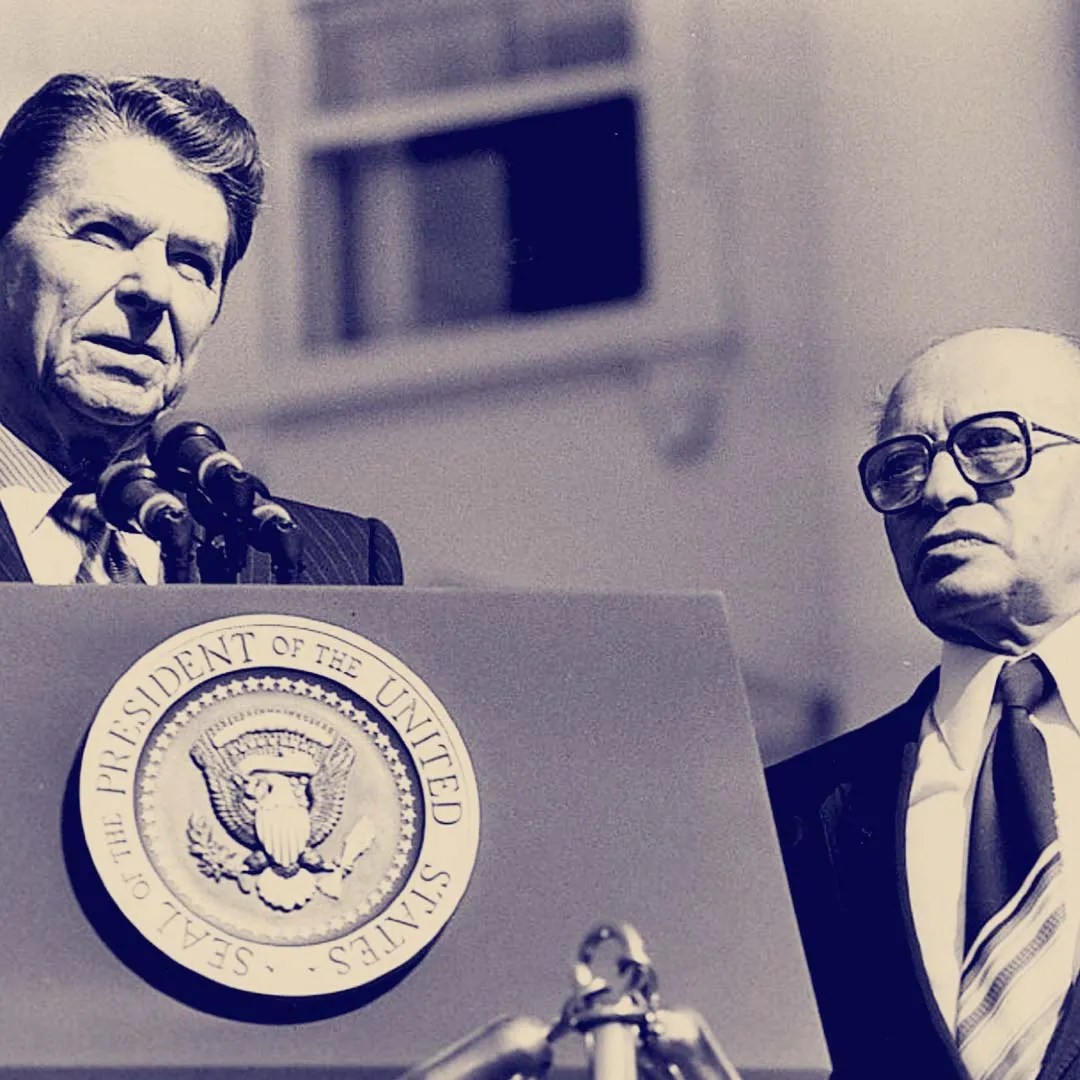
Ronald Reagan and Menachem Begin. Source: Haaretz.
One telling incident from this period comes to mind during the Ronald Reagan presidency.
«Those who are now destroying the cemeteries of the Soviet soldiers will still pay for doing so. Nature will take revenge on them and their children although they may not believe this now. No one can cancel the law of historical karma. This law always catches up to the grave robbers.»
-Oles Buzina
Notes on Context, Editing, and Translation
This article was originally called “Stories from Oles Buzina: Under the Greatcoat of Victory” from the popular Ukrainian author’s “Stories from Oles Buzina” series. It was published in May 2009. As mentioned with all the other Buzina translations, their author was assassinated in 2015 likely for his political views, including those against the 2014 regime change in Ukraine. You can find the other Buzina translations below by using the appropriate “Buzina” hashtag.
Even though the original was written in 2009, it remains ever more relevant. Echoes of World War II permeate the ongoing conflict in Ukraine that began in 2014 as the war in Donbass. For example, Buzina disparages the 21st-century supporters of the Third Reich collaborators in 1940s Ukraine. These present-day supporters have been receiving international media attention since 2022. Parallels between then and now are also evident when it comes to Nazi Germany’s plans for Crimea as a resort exclusively for Germans and what some alleged to be NATO’s failed plans to turn Crimea into a naval base in 2014.
The article is written in Buzina’s signature style combining his caustic sense of humor with historical deep dives. This style is particularly evident in his description of the Munich Agreement (1938) highlighting it as a precedent that subsequently forced the Soviet Union into a neutrality agreement, the Molotov-Ribbentrop Pact (1939), with Nazi Germany. However, it is important to note that Buzina then refers to the Soviet Union and Nazi Germany as “allies”—for a short time. This classification is inaccurate because a non-aggression, or a neutrality, agreement, is not a military alliance. Furthermore, prior to Molotov-Ribbentrop came other similar agreements with Nazi Germany, including the German-Polish declaration of non-aggression in 1934. Thus, the Soviet-German neutrality agreement was not unique.
Note that when the author refers to the “war,” he means the Great Patriotic War, the accepted term for the period between 1941 and 1945 in World War II historically used by the USSR and today—by Russia and parts of the former Soviet Union. Buzina also repeatedly mentions the period of 1941-1944: these are the dates for Nazi German occupation of the Ukrainian territory called Reichskommissariat Ukraine prior to the Soviet liberation. “May 9” refers to the official Victory Day in Russia and the post-Soviet states.
Editorial clarifications are labeled “Ed.” in parentheses.
The translation appears as is. Minor edits include using a person’s first name in the first instance or other types of minor clarifications. The names and toponyms are transliterated from the Russian original.
As requested, here is my new video investigation about Vladimir Putin’s path to the KGB. It is full of interesting historical tidbits. And how could I leave out World War II?
Enjoy!
One-Time
Monthly
Yearly
Supporting my work allows me to bring you content on a regular basis.
The original article was entitled “Stories from Oles Buzina: Bandera—the Cat Strangler” written by a prominent Ukrainian journalist Oles Buzina and published on January 29, 2010. Buzina was a Ukrainian patriot who believed Russians, Ukrainians, and Belarussians were triune. He was critical of the gradual imposition of the minority Galician (western Ukrainian) identity onto the majority of Ukraine even before the 2014 Maidan. For example, in this article, the author criticizes Ukraine’s former President Viktor Yushchenko brought to power through the so-called Orange Revolution in 2004. Some consider the 2004 event to be a proto-regime change in that country that succeeded in 2014. In 2010, Yushchenko posthumously granted Nazi collaborator Stepan Bandera the Hero of Ukraine title. Bandera lived in Polish-controlled Galicia outside the Ukrainian Soviet Socialist Republic in the 1920s-1930s and then in Munich, Germany.The latter is an early negative-identity example along the same trajectory as the post-2014 attempts to “cancel” the Russian language and heritage and even remove monuments to the Soviet WWII military leaders.
«Any politician who tries to impose Bandera as Ukraine’s hero will not only destroy his personal career…but will also destroy the country.»
Oles Buzina, in “Unheroic ‘bandera’,” January 2011
In April 2015, Buzina was assassinated outside his Kiev home—allegedly for his vocal criticism of the Maidan. The murder was one of the first key signs of political radicalization in Ukraine. I have previously translated him here.
The article is presented in its entirety. The only deviation from the original is using the first name the first time each new individual is mentioned. Square brackets are editorial clarifications.
Stepan Bandera—the Cat Strangler
by Oles Buzina
It’s too bad that [Ukraine’s President (2005-2010)] Viktor Yushchenko doesn’t know history very well. With his decree making Stepan Bandera a national hero [of Ukraine], he spat in the soul of animal rights advocates all around the world by awarding an animal abuser.
As a writer, what impresses me the most in the story of the newly minted “hero of Ukraine,” is the completeness of the gastronomical theme. On Bandera’s order in 1934, the Interior Minister of Poland, Bronisław Pieracki, was assassinated as he entered a cafe in Warsaw to grab a bite to eat. The mastermind and organizer of this “attentat” (what they call assassination attempts in Galicia [Ukraine]), the half-educated student Bandera was only 25 years old. He was halfway through his life path which he did not suspect.
The Soviet Union fought against the followers of a convicted terrorist and Nazi German collaborator Stepan Bandera in western Ukraine—first during World War II and then as an insurgency. As a result, many were tried and incarcerated in Kazakhstan, the Arctic Circle, and the Urals. Yet in 1955, Soviet leader Nikita Khrushchev pardoned and released Banderites in the tens of thousands. Why did this mass-scale amnesty happen, and what long-term consequences did it have?
This question is especially perplexing considering who Stepan Bandera was—a fascist leader of the terrorist OUN, Organization of Ukrainian Nationalists (faction B named after Bandera), established in 1929. During World War II, the organization collaborated with Nazi Germany since the area was under their occupation as Reichskommissariat Ukraine from mid-1941 to late 1944.
“We never tried to wake our children up on weekends: the more they sleep, the less they eat.”
-Natalia
Recently, the Russian-speaking segment of the Internet got flooded with personal photographs from the 1990s. I first took note of them on my own Facebook feed. Some appeared expectedly funny—imagine the hairstyles!—others were nostalgic. Yet what seemed like a spontaneous flashmob turned out to be a planned event. In fact, this social-networking experiment was organized by the Yeltsin Foundation in conjunction with one opposition publication. It targeted the under-40 demographic, but especially those born in the late 1980s-early 1990s, who were too young to remember some of the horrors of that decade. Thus, the purpose of this pseudo-spontaneous photo-sharing was to reshape the memory of a nation about the early years following Soviet collapse. This memory has been overwhelmingly negative: looting the country’s natural resources by the select few, mob violence in the streets, daily hunger, institutional collapse, and national humiliation, just to name a few aspects.
Much like his caustic historic text on SS Galicia, Ukrainian author Oles Buzina was not very fond of Stepan Bandera—another one of official Kiev’s current ‘heroes’. This following prophetic text, written in 2011, also demonstrates why Buzina became a political dissident in his own home and possible reasons for his assassination in the spring of 2015.
* * * * *
STORIES FROM OLES BUZINA: UNHEROIC “BANDERA” (2011)
(“Stories from Oles Buzina” was a regular column for Segodnya newspaper, covering historic subjects. In the Russian language, “story” and “history” (istoriia) are the same word, which plays an important role in this context.)
Demoted! On January 12th, 2011, the website of the president of Ukraine reported that Stepan Bandera lost his official title of Hero.
The views of the original author do not necessarily reflect those of the translator.
It is not by accident that I wrote the word “bandera” in the feminine and in lower-case letters, despite the fact that this article will discuss that very same Bandera, who was a man and whose proper name, according to grammar, naturally began with a title-case letter.
With the onset of the Ukrainian crisis, I realized that I often looked forward to the work of certain journalists, who were both eloquent and informative. Oles Buzina was one of them. In addition to reading his columns, I, like millions of other Russians, watched his frequent appearances on political talk shows. I often found myself in disagreement, but had to admit that his points were well-argued and factually justified—a true sign of a charismatic erudite.
Thus, the news of his brazen murder on April 16 of this year, in broad daylight and outside his home, was particularly distressing. Later, I found out that Oles—a well-known author and historian, in addition to his journalistic career—had been receiving threats for quite some time. Yet he consistently turned down offers to relocate to Russia. Like a true patriot of a country in peril, he continued to love Ukraine. But Ukraine—today’s Ukraine—did not return that sentiment.
Alexander Solzhenitsyn is one of the best-known Soviet dissidents, so much so that he earned the Nobel Prize in Literature in 1970. His Gulag Archipelago, written in the 1950s-60s, and One Day in the Life of Ivan Denisovich from 1962—both about the Stalin-era labor-camp system—are his most famous works outside of Russia. Yet after the collapse of the USSR, it became increasingly clear that much of his foreign support was not inspired by the Western ideal of ‘human rights’ or concern for average Russians, but served as a tool of geopolitics instead.
His statements about resurgent Russia, particularly in the last years before his death in 2008–well into the era of Putin’s leadership–did not suit those that would rather have the country in the permanently weak state of ‘freedom’ and ‘democracy’ of the 1990s, so that its resources could continue being plundered by domestic oligarchs and foreigners alike, while its culture–transformed into the soft authoritarianism of neo-Liberal Postmodernity. In contrast, one of the most attractive aspects of Putin’s Russia for Solzhenitsyn was the revival that Orthodox Christianity continues to experience.
“There are no separate Russia or Ukraine, but one Holy Rus” – Elder Iona of Odessa
The year 2014 saw an unprecedented surge of patriotism in contemporary Russia, which resulted in popularizing the notion of the Russian World. One reason for the increased patriotic sentiment was Crimea’s return to the home port after the overwhelmingly positive vote by its majority-Russian residents in a referendum one year ago. The onset of the liberation war in Donbass from the West-backed Kiev regime was the other. This war truly delineated the stakes for the existence of the Russian World. The latter is not an ethnic, but a civilizational concept that encompasses shared culture, history, and language in the Eurasian space within a traditionalist framework. To a certain extent and despite the obvious ideological differences, the Russian Empire and the USSR embodied the same geopolitical entity. A particularly noteworthy aspect of the ongoing crisis in Donbass is the symbolism—religious and historic—that surpasses the commonly used, but outdated Left-Right political spectrum. In the Russian context, this also means overcoming the Red-White divide of the Communist Revolution. That this war pushed Russians to examine their country’s raison d’être is somewhat remarkable: for two decades its citizens did not have an official ideology, prohibited by the Constitution that is based on Western models. The emergence of a new way of thinking in Russia will become clearer once we refer to the meaning of religious insignia, wars—Russian Civil and Great Patriotic, as well as the question of ideology in the Postmodern world.
 Nina Byzantina