Russia Is Energizing Africa, and the Monsters of the Underworld Are Powerless to Stop It

Russia and China “are very active and of course, they have a different financing model, which allows them to move more flexibly, including in international markets, so that is the challenge for American companies abroad.”

International Atomic Energy Agency (IAEA) Director General, Rafael Grossi

Source: TASS

Energy cooperation was one of the key areas of discussion during the Russia-Africa Summit held in St. Petersburg in July 2023. The summit made the official Western media and think tanks scoff and some politicians scramble to “counter Russian influence” in the region. There was so much scrambling, in fact, that the official West brought out the big guns: a well-known ancient Chthonic Creature known for its poisonous Cookies of Doom was sent on a mission to Africa.

Witnesses claim that the Chthonic Creature looked a little like Ivan Bilibin’s illustration from 1934. Any resemblance to real-life individuals is coincidental. Obviously.

Russia is known as a global commodity and energy powerhouse, including the oil-and-gas sector. So much so that those particularly green with envy once called it “a gas station masquerading as a country.” It was not until the self-defeating sanctions courtesy of the so-called Euro-Atlantic community—all tens of thousands of them—were implemented against Russia starting in 2022, that the extent to which commodities and real-world industrial production matter became truly clear. As Europe’s industrial leader, Germany, reels from the effects of these misguided sanctions, its business community, no doubt, misses cheap Russian gas.

Continue reading

Misinformation, Media, and the Social Mood in 20th-Century Civil War-Era Ukraine

«The newspapers—going mad from all the contradictory rumors—willingly printed all this nonsense…These rumors lost their direct purpose of reporting fictitious “facts”…They turned into a means of self-soothing or a powerful narcotic medicine. Only in rumors, people found hope for the future. Even outwardly, Kiev residents began to resemble morphine addicts.»

Editor’s and Translator’s Note

Thinking about the chaos that seems to periodically erupt in the territory of Ukraine, a Hegelian would argue that there are historical inevitabilities that explain such large-scale events. A student of geopolitics would add that the relationship between land and politics backed by the knowledge of history shapes our understanding of the world. On more than one occasion, we discussed the striking parallels between the turbulent events of the early 20th-century Russian Civil War in the territory of Ukraine and the present-day conflict in the region. Yet, the following excerpt from Konstantin Paustovsky’s autobiographical The Story of a Life (1962) goes even further to shed light on mis- and disinformation, mass media, as well as the social mood in Kiev immediately after the 1917 Revolution.

After all, Paustovsky, a Nobel Prize-nominated Soviet author, spent his youth between Moscow and Kiev. While in Kiev, he documented his perceptions of the frequent changes in the self-proclaimed governments, foreign “interventions,” and the way in which the public responded to them. In this sense, his writing is valuable because it provides an additional dimension to understanding war propaganda both a century ago and today.

The translation is generally presented as is. Exceptions include using the full names where they were omitted in the original and providing editorial notes for context. As always, translation is an art, not a science. For instance, in some cases, I translated the word “power” (vlast‘)—in reference to those who ruled during the Civil War—as a “regime” because the author did not use the term “government,” and this translation is more in line with the theme.

The Story of a Life (Excerpt)

Konstantin Paustovsky

1962

The regime of the Ukrainian Directorate and Symon Petliura looked provincial. The once-brilliant Kiev turned into an enlarged Shpola or Mirgorod with their formulaic presences and Dovgochkhuns (Ivan Dovgochkhun is a character in How the Two Ivans Quarrelled (1834) by Nikolai Gogol – Ed.) who presided in them.

Saint Sophia, pre-revolutionary Kiev, early 20th century.
Continue reading

The War on Orthodox Christianity in Ukraine

«We will not cast pearls before you, Muscovite swine. You are a powerless biomass. We will not only take this church from you, but we will also take everything. We will kick you out from our land and from the Kiev-Pechersk Lavra.»

-Greek Catholic priest Nikolai Medinsky, Kolomyia, Ivano-Frankovsk oblast, Ukraine, October 27, 2017. He made this statement following the capture and an attempt to expel the Orthodox from the Annunciation church built more than 100 years prior to the establishment of the Greek Catholic Church in Galicia.

In 2023, the Kiev-Pechersk Lavra, an important historic site for Orthodox Christianity, is under siege by the Ukrainian government. Its Metropolitan Pavel has been charged with “inciting religious hatred” and placed under house arrest. Yet the state’s persecution of the canonical Orthodox Church is the culmination of the brewing clash involving politics and identity since the establishment of independent Ukraine following the collapse of the Soviet Union. Its causes are far more complex and go back centuries when the Ukrainian territory was part of multiple states (Russia, the Polish-Lithuanian Commonwealth, the Austro-Hungarian Empire, and the Ottoman Empire).

Kiev-Pechersk Lavra, by Vasily Vereshchagin, 1905.

Indeed, when the new Ukrainian state emerged in 1991, it was based on two conflicting identities of the western minority and the eastern and southern majority, respectively. These identities were part of different geopolitical entities for centuries, in which culture, language, and religion played a key role. This is not to say that new states cannot be successfully formed, or that different identities within them cannot coexist. But the latter requires state mechanisms to facilitate such coexistence such as federalization and recognizing more than one state language.

Continue reading

The Story of a Real Man

This interview initially appeared in Komsomolskaya Pravda on December 7, 2022. It was entitled, “A Pilot of the Russian Aerospace Forces: ‘We decided not to give up. The navigator took the grenade, and I pulled the ring out of it.'”

Editor’s Note:

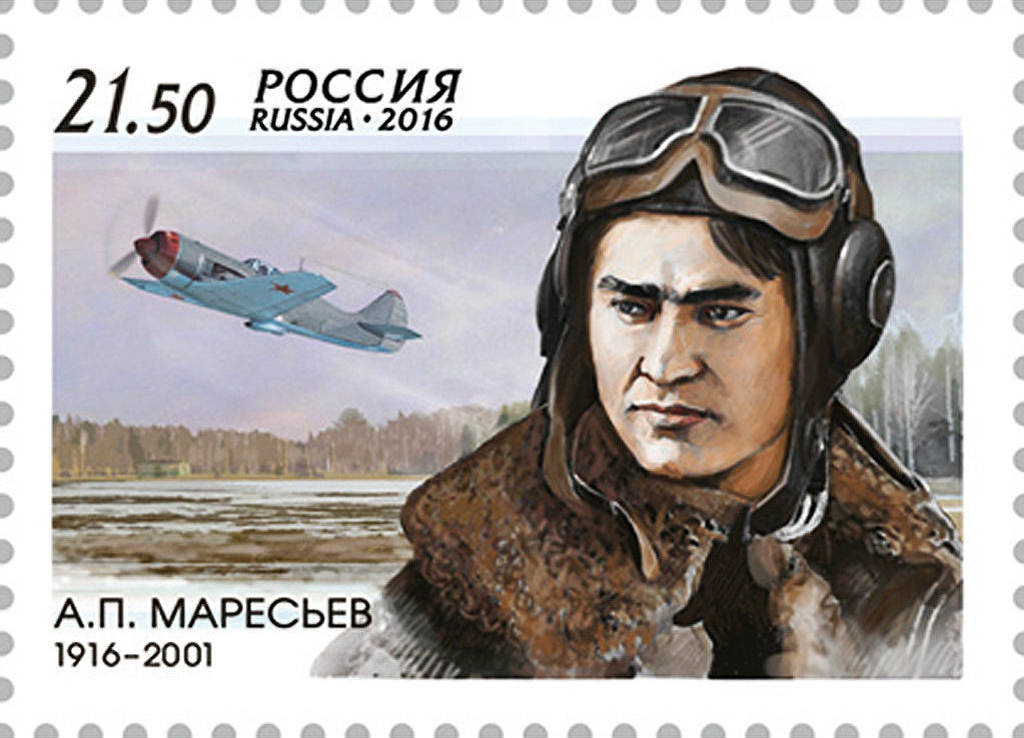
The Story of a Real Man by Boris Polevoy (1946) referenced below is about Soviet fighter ace Alexey Maresyev (1916-2001). During World War II, Maresyev’s plane was shot down but he managed to return to the Soviet side. He was injured so severely that both of his legs had to be amputated above the knee due to gangrene. Not only was Maresyev able to recover but he returned to flying a year later, in 1943, despite his disability. In total, he is credited with 80 combat sorties. Maresyev earned Hero of the Soviet Union. In 1947-48, renowned composer Sergei Prokofiev turned Marasyev’s experience into an opera.

In the original Russian title, “man” refers to a “person” (chelovek), but the standard English translation is “man.”

2016 Russian stamp featuring WWII hero Marsyev. Source: Wikipedia Commons (public domain).

Pilot Pyotr Kashtanov, awarded Hero of Russia, defeated the enemy and escaped being captured. Kashtanov successfully carried out his combat mission and destroyed enemy equipment. However, the crew was hit and catapulted into enemy territory. The “nationalists” were close by, while his comrade was unconscious…

Source: Pyotr Kashtanov’s personal photo archive.

On the eve of Heroes of the Fatherland Day [December 9], Komsomolskaya Pravda journalists met with an officer whose airplane was shot down over enemy territory. Yet he completed his combat mission and, despite being wounded, led the crew to rejoin the Russian troops.

Not very tall, humble, and seemingly very young, the senior lieutenant tries to be sociable and relaxed.

– Pyotr, he extends his right hand.

Based on his weak handshake, as if it were unnaturally constrained, we understand that the pilot has not yet fully recovered. In September, his Su-34 fighter bomber was shot down over enemy territory, while on a combat mission in the Special Operation zone [during the international conflict taking place in Ukraine]. The situation was hopeless. He had a broken arm, while the navigator had a compression fracture of the spine. There were enemies all around. Yet by some miracle, both managed to get out and reached their own comrades.

And now, sitting in front of us, as if descended from the pages of Boris Polevoy’s The Story of a Real Man, is Pyotr Kashtanov, a Russian officer. The star of the Hero of Russia sparkles on the chest of this 31-year-old…

Continue reading

Do You Realize What You Have Done: Brussels Bombing in Context

Instead of the triumph of democracy and progress, we got violence, poverty and social disaster — and nobody cares a bit about human rights, including the right to life. I cannot help asking those who have forced that situation: Do you realize what you have done?

-Vladimir Putin addressing the United Nations in September 2015.

March 22, 2016 entered contemporary history as another day made dark by a new terrorist act in Europe. This time it took place in Brussels, Belgium roughly following the general pattern of its Parisian predecessor in late 2015 by targeting multiple heavily populated areas: a major metro station and the city’s airport. These violent acts resulted in dozens of deaths and hundreds of injuries and were later attributed to the so-called Islamic State terrorist group, although at the time of writing the criminal evidence is just making its way into the media.

SYMBOLS OF EUROPEAN POSTMODERITY

Whereas some described the Paris attacks as targeting the very heart of European culture and civilization, the 2016 bombing of Brussels symbolizes the war against the capital of the European Union and all it represents, as well as the NATO headquarters, the most powerful military alliance in the world. Indeed, border closures alone in the wake of such crises undermine the very idea of this Union and thus send a strong message. Terrorism’s raison d’être is to cause maximum disorientation and fear among the civilian population, which is why, it seems, the perpetrators chose public spaces rather than government buildings.

Continue reading

Hounding the Bear: Hybrid Methodology of Containing Russia

Bear-hounding is a hunting technique, in which a pack of dogs pursues a bear until exhaustion—at that point the hunter can make his kill. And that is to what Karen Shakhnazarov, a well-known Russian filmmaker of Armenian origin, compared Russia’s predicament in the current geopolitical situation.

russian bear cartoon

As the Tariff-War Must End, Udo Keppler, Puck, U.S., 1901. Source: LOC.

The bear analogy in Russia’s case is a contrived and, often, derogatory image describing the barbaric Other outside the West. It has deep historic roots, as literary and artistic examples indicate. But it is also one that works metaphorically. As a large continental power spanning Eurasia including some of the coldest places on earth—one with nuclear capabilities—Russia is not unlike the bear. In fact, many Russians themselves have reappropriated this comparison.
Even President Vladimir Putin has used it on a number of occasions.

Continue reading

If You’re So Smart, Then Why Are You So Poor? Russia’s 1990s Revisited.


“We never tried to wake our children up on weekends: the more they sleep, the less they eat.”

-Natalia

Recently, the Russian-speaking segment of the Internet got flooded with personal photographs from the 1990s. I first took note of them on my own Facebook feed. Some appeared expectedly funny—imagine the hairstyles!—others were nostalgic. Yet what seemed like a spontaneous flashmob turned out to be a planned event. In fact, this social-networking experiment was organized by the Yeltsin Foundation in conjunction with one opposition publication.  It targeted the under-40 demographic, but especially those born in the late 1980s-early 1990s, who were too young to remember some of the horrors of that decade. Thus, the purpose of this pseudo-spontaneous photo-sharing was to reshape the memory of a nation about the early years following Soviet collapse. This memory has been overwhelmingly negative: looting the country’s natural resources by the select few, mob violence in the streets, daily hunger, institutional collapse, and national humiliation, just to name a few aspects.

Continue reading

State Propaganda? Realities of the Russian Media Landscape

The trope of ‘Russian state propaganda’ in mainstream Western media is a persistent one, especially as of late. This continued focus expresses one’s own loss of control as older cable-news models are in decline, the media landscape becomes more diverse, and various web platforms allow younger savvy users to locate alternative information sources. This kind of repetitive finger-pointing is also simultaneously meant to delegitimize Russia’s foreign-language broadcasting and to explain the support for Putin domestically.

The notion in question relies on a number of related assumptions:

  • that Western countries do not have state media;
  • that corporate media is impartial;
  • that state media cannot feature opposing points of view and is thus inferior to its corporate counterpart;
  • that media consumers, the general and even the educated public, are incapable of critically analyzing the information they receive.

Continue reading

The Walking Dead: Russia’s Immortal Regiment as Ancestor Veneration

“You are but millions. We are hordes and hordes and hordes.” (“Scythians,” Alexander Blok, 1918)

On May 9, 2015, Ban Ki-moon, the United Nations Secretary-General, was on an official visit to Moscow in order to commemorate the 70th anniversary of the end of the Second World War in Europe. Upon seeing countless people marching in the streets, he assumed that what he was witnessing was an anti-Putin protest. This kind of ‘misunderstanding’ was not a surprise. After all, European and North American mainstream media is fond of exaggerating anti-government protests—by a handful of affluent pro-Western ideological Liberals—that are limited to large urban centers. Yet that day, foreign journalists were forced to cover something unprecedented, though underestimating the numbers: half a million Muscovites marched through the city carrying mounted photographs of their family members, who participated in the Great Patriotic War (1941-1945).

But then I saw that, on the contrary, the marchers hailed your government. I saw that they did it with pride, I saw it in their faces. They waved to us as the UN delegation passed by, which was very pleasant. And so I really think you deserve all this love of the people.

Continue reading

Stories from Oles Buzina: SS Galicia Division against Ukraine

Foreword to the Translation

With the onset of the Ukrainian crisis, I realized that I often looked forward to the work of certain journalists, who were both eloquent and informative. Oles Buzina was one of them. In addition to reading his columns, I, like millions of other Russians, watched his frequent appearances on political talk shows. I often found myself in disagreement, but had to admit that his points were well-argued and factually justified—a true sign of a charismatic erudite.

Thus, the news of his brazen murder on April 16 of this year, in broad daylight and outside his home, was particularly distressing. Later, I found out that Oles—a well-known author and historian, in addition to his journalistic career—had been receiving threats for quite some time. Yet he consistently turned down offers to relocate to Russia. Like a true patriot of a country in peril, he continued to love Ukraine. But Ukraine—today’s Ukraine—did not return that sentiment.

Continue reading