Russian-American Aviator Sikorsky and the Failure of Ukrainian and Western Propaganda

«We are Russians, and Kiev is ours.»

~Ivan Sikorsky, psychiatrist and Igor Sikorsky’s father

Since the 2022 escalation of the 2014- war in Ukraine, major Western media sources have been routinely churning out article after article sprinkled with glowing, thinly veiled propaganda about the supposedly heroic feats performed by Ukraine’s 18th Separate Army Aviation Brigade, named after aviator Igor Sikorsky. The Sikorsky Brigade for short. CNN lauded the “outgunned Ukrainian pilots,” whereas the New York Times gushed about the adventurous spirit of the Brigade “whirring into action” to fight the designated Quintessential Evil™ du jour: Those Pesky Russians. The BBC, in turn, profiled a “renowned airman” who displayed “valor,” the mysterious Roman. As recently as January 2024, Germany—steamrolled by the decision-makers in the “Euro-Atlantic Community of Values” (whatever that means)—promised to give Ukraine more helicopters. Sikorsky Sea King helicopters likely going to the Sikorsky Brigade. Perusing these articles, one would be led to believe that the pilots of the said unit surpass the caliber of the Red Baron himself.

Ukraine’s 18th Sikorsky Brigade. Source: Facebook.

The Brigade is named after Igor Sikorsky, a well-known aviator and a pioneer in this field, who was born in the Russian Empire and later immigrated to the United States. Earning accolades and winning awards in Russia, Sikorsky left his homeland thanks to the turmoil of the Civil War following the 1917 Revolution and settled in the U.S. There, he launched the Sikorsky Aircraft Corporation in 1923. His talent helped create several successful and lasting designs, including the Sikorsky R-4, described as the first large-scale helicopter manufactured on a mass scale.
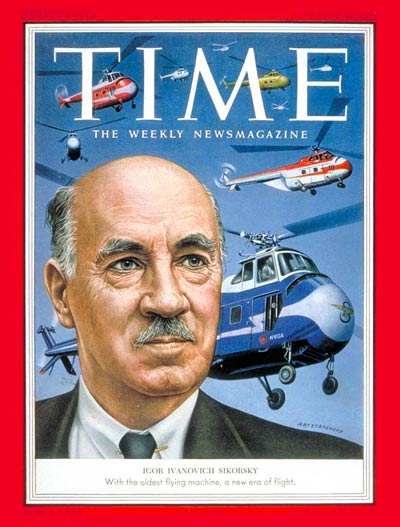
Aviator Igor Sikorsky on the cover of Time magazine, 1953.

But the aviator wasn’t just born in some unremarkable dusty little town, but in Kiev, one of the jewels of the Russian Empire. Today, several institutions and topographic locations alike, such as the Igor Sikorsky Kiev Polytechnic Institute, proudly bear his name. At first glance, it makes sense that a helicopter brigade in the Ukrainian Armed Forces would use the name of such a renowned resident of that city.  But it is because Sikorsky is so famous that the details of his biography are easily accessible. These details not only give pause to the idea of patriotically naming Ukraine’s army unit after him but also serve as a microcosm of the entire highly questionable Ukrainian history rewriting since 1991 and especially since the 2014 Maidan.

Continue reading

The War on Orthodox Christianity in Ukraine

«We will not cast pearls before you, Muscovite swine. You are a powerless biomass. We will not only take this church from you, but we will also take everything. We will kick you out from our land and from the Kiev-Pechersk Lavra.»

-Greek Catholic priest Nikolai Medinsky, Kolomyia, Ivano-Frankovsk oblast, Ukraine, October 27, 2017. He made this statement following the capture and an attempt to expel the Orthodox from the Annunciation church built more than 100 years prior to the establishment of the Greek Catholic Church in Galicia.

In 2023, the Kiev-Pechersk Lavra, an important historic site for Orthodox Christianity, is under siege by the Ukrainian government. Its Metropolitan Pavel has been charged with “inciting religious hatred” and placed under house arrest. Yet the state’s persecution of the canonical Orthodox Church is the culmination of the brewing clash involving politics and identity since the establishment of independent Ukraine following the collapse of the Soviet Union. Its causes are far more complex and go back centuries when the Ukrainian territory was part of multiple states (Russia, the Polish-Lithuanian Commonwealth, the Austro-Hungarian Empire, and the Ottoman Empire).

Kiev-Pechersk Lavra, by Vasily Vereshchagin, 1905.

Indeed, when the new Ukrainian state emerged in 1991, it was based on two conflicting identities of the western minority and the eastern and southern majority, respectively. These identities were part of different geopolitical entities for centuries, in which culture, language, and religion played a key role. This is not to say that new states cannot be successfully formed, or that different identities within them cannot coexist. But the latter requires state mechanisms to facilitate such coexistence such as federalization and recognizing more than one state language.

Continue reading

The Walking Dead: Russia’s Immortal Regiment as Ancestor Veneration

“You are but millions. We are hordes and hordes and hordes.” (“Scythians,” Alexander Blok, 1918)

On May 9, 2015, Ban Ki-moon, the United Nations Secretary-General, was on an official visit to Moscow in order to commemorate the 70th anniversary of the end of the Second World War in Europe. Upon seeing countless people marching in the streets, he assumed that what he was witnessing was an anti-Putin protest. This kind of ‘misunderstanding’ was not a surprise. After all, European and North American mainstream media is fond of exaggerating anti-government protests—by a handful of affluent pro-Western ideological Liberals—that are limited to large urban centers. Yet that day, foreign journalists were forced to cover something unprecedented, though underestimating the numbers: half a million Muscovites marched through the city carrying mounted photographs of their family members, who participated in the Great Patriotic War (1941-1945).

But then I saw that, on the contrary, the marchers hailed your government. I saw that they did it with pride, I saw it in their faces. They waved to us as the UN delegation passed by, which was very pleasant. And so I really think you deserve all this love of the people.

Continue reading